Eastern subterranean termites (Reticulitermes flavipes) dwell entirely within moist Piedmont soil, requiring continuous ground contact to survive while consuming cellulose framing members inside living areas. In…
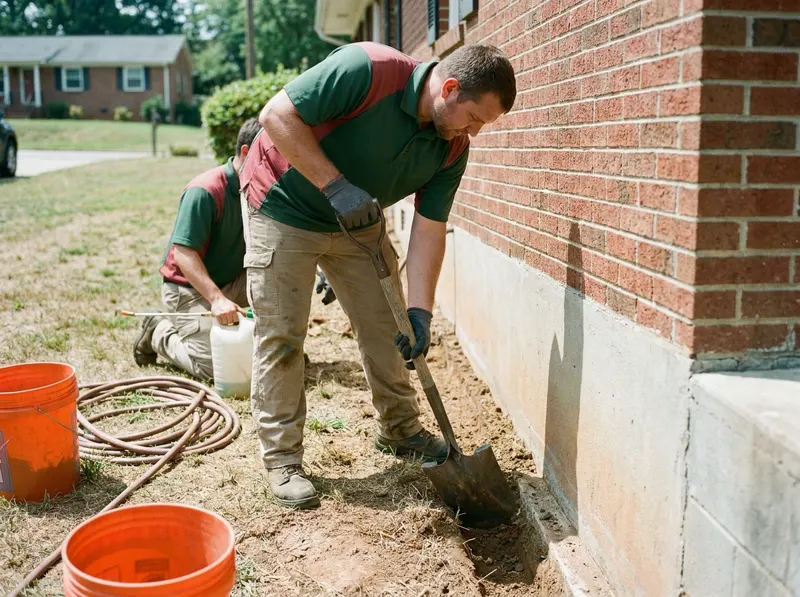
Eastern subterranean termites (Reticulitermes flavipes) dwell entirely within moist Piedmont soil, requiring continuous ground contact to survive while consuming cellulose framing members inside living areas. In Greensboro neighborhoods like Fisher Park, Westerwood, and Latham Park, historic homes constructed over crawlspaces with unsealed masonry piers often expose perimeter floor joists to unchecked exploratory mud tubes. Subterranean termite soil trenching creates a continuous chemical curtain along every exterior foundation wall, ensuring that foraging worker termites transfer slow-acting active ingredients back into deep subterranean nests, halting structural contamination without dispersing volatile airborne chemicals into family living spaces.
Decision guidance depends heavily on foundation architecture and the surrounding landscape grade. Soil trenching fits properties with exposed earth perimeters, accessible crawlspace walls, and established subterranean activity along exterior footings; bait stations fit scenarios where dense hardscaping, steep stone terraces, or proximity to open surface water prohibit deep soil disruption. The trade-off centers on immediacy versus structural intrusion: liquid soil trenching establishes immediate perimeter defense inside saturated earth and carries a multi-year residual barrier, whereas surface stations require weeks of continuous feeding cycles before colony suppression occurs.
Soil composition across Guilford County directly governs chemical displacement and installation depth. Starmount Forest, Irving Park, and Hamilton Lakes frequently feature heavy, compact Cecil clay loam that limits vertical termiticide diffusion if untreated. Soil trenching overcomes dense local clay by physical mechanical displacement: technicians excavate a 6-inch wide by 6-inch deep trench immediately abutting foundational footings, inject rodding tools deep into sub-grade strata, and backfill the excavated earth while treating every 10 linear feet with 4 gallons of termiticide emulsion. Attached patios, porches, and concrete walkways around properties in Adams Farm and Sedgefield receive vertical core drilling at 12-inch centers to ensure an unbroken subsurface perimeter barrier that shields interior nesting zones.
Every job gets a firm, written price after a free on-site visit.
Tell us about your subterranean termite soil trenching job in Greensboro and we'll send a clear, written quote, usually the same day.
 CleanNest Pest Management