Foliage barrier mosquito suppression addresses adult *Aedes albopictus* (Asian tiger mosquito) populations where they rest during daylight hours rather than blanketing open turf or living areas in broadcast…
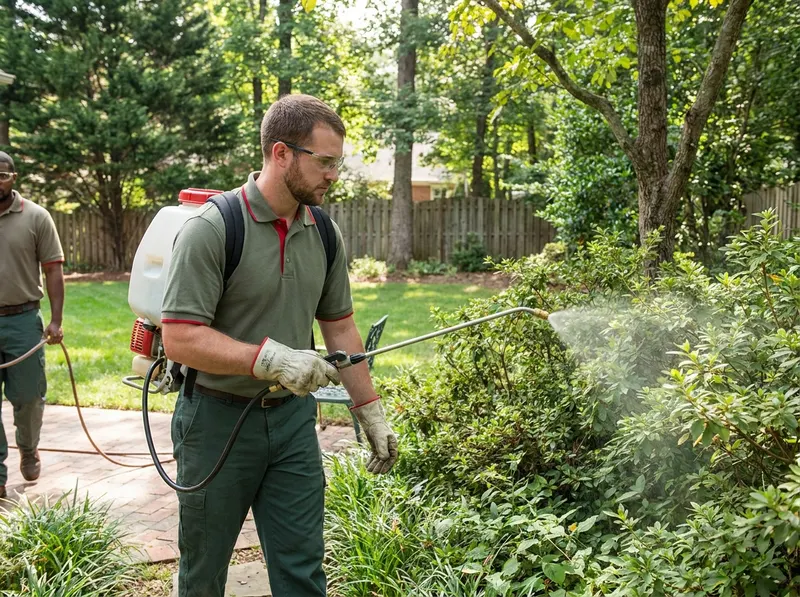
Foliage barrier mosquito suppression addresses adult *Aedes albopictus* (Asian tiger mosquito) populations where they rest during daylight hours rather than blanketing open turf or living areas in broadcast insecticides. Mosquitoes avoid direct midday sun and spend over 80% of their adult life cycle clinging to the cool, humid undersides of broadleaf foliage beneath the 10-foot vertical threshold. In established Greensboro communities like Fisher Park, Irving Park, and Westerwood, deep tree canopies and mature historic landscaping create continuous shade corridors that shelter high insect densities. Precision air-assisted backpack sprayers apply calibrated micro-droplets directly onto lower leaf surfaces. This targeted delivery establishes an adhesive barrier that eliminates adult pests on contact while preserving open lawn spaces and family recreation areas.
Property moisture dynamics dictate the frequency and formulation balance of exterior pest management. Neighborhoods bordering surface water systems, such as properties adjacent to Lake Daniel in Latham Park, the natural wetlands around Hamilton Lakes, or stream-fed lots near Starmount Forest, maintain elevated relative humidity that accelerates mosquito breeding. When standing water cannot be completely cleared due to marshy grade or root cavities, water-soluble *Bacillus thuringiensis israelensis* (BTI) tablets are placed into stagnant reservoirs to neutralize pupae without affecting soil chemistry or avian life. For properties in Adams Farm, Lindley Park, and Sedgefield characterized by manicured ornamental plantings, treatment concentrates on low-hanging branches, deck undersides, and foundation perimeters where adult vectors aggregate.
Selecting barrier foliage treatment involves balancing longevity against ecological boundaries. Broadcast thermal fogging provides immediate, non-residual contact kills lasting fewer than 24 hours, making it unsuitable for persistent neighborhood populations. Foliage barrier misting utilizes micro-encapsulated polymers that bond to plant cuticles, resisting normal precipitation events across a 21-to-28-day window. The trade-off is geographic precision: flowering blooms, pollinator gardens, and open vegetable beds are excluded from direct chemical application by a mandatory 15-foot buffer to protect foraging honeybees. Initial service begins with property mapping, followed by physical elimination of container breeding water, precision leaf-canopy application, and confirmation of a 60-minute post-treatment dry time before outdoor spaces return to domestic use.
Every job gets a firm, written price after a free on-site visit.
Tell us about your foliage barrier mosquito suppression job in Greensboro and we'll send a clear, written quote, usually the same day.
 CleanNest Pest Management