Older architecture throughout Fisher Park, Westerwood, and Lindley Park frequently features vented crawl spaces resting on unsealed masonry curtain walls. Norway rats and white-footed mice require an aperture of merely…
Older architecture throughout Fisher Park, Westerwood, and Lindley Park frequently features vented crawl spaces resting on unsealed masonry curtain walls. Norway rats and white-footed mice require an aperture of merely one-quarter to one-half inch to enter these substructures, often exploiting plumbing penetrations, rusted crawl space access doors, or gaps beneath band joists. Homes situated near water runoffs, such as Latham Park or the stream corridors winding through Starmount Forest and Hamilton Lakes, face continuous rodent pressure as autumn temperatures decline. Rodents nesting in fiberglass floor batts contaminate indoor air circulating upward via the stack effect, which draws up to 50 percent of ground-floor air directly from the crawl space.
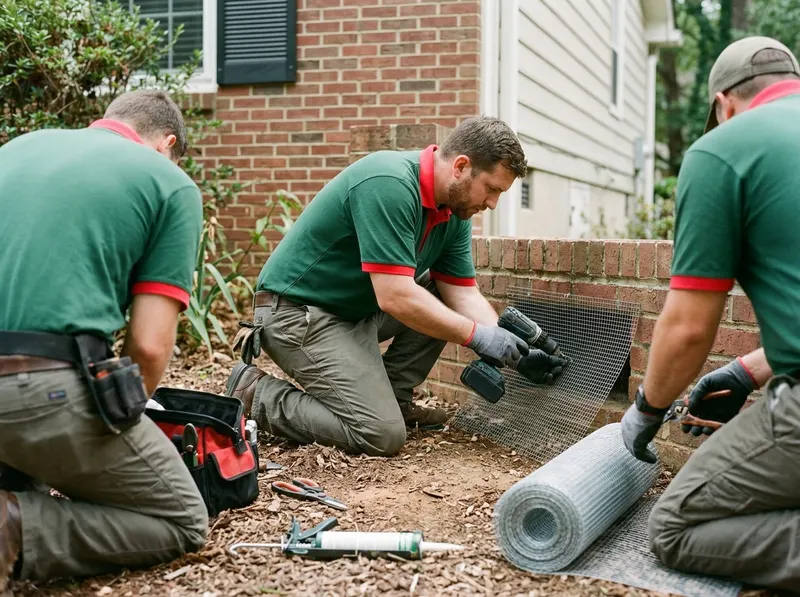
Complete crawl space rodent exclusion prioritizes physical barrier defense over chronic poison baiting. Relying strictly on rodenticides leaves toxic baits accessible to domestic pets and causes rodents to perish inside floor cavities, creating secondary odor and insect issues. Mechanical exclusion utilizes 19-gauge galvanized hardware cloth, copper mesh, and pest-rated expanding foam to block entry at every rim joist, pipe trench, and foundation vent. For properties in Irving Park, Adams Farm, or Sedgefield with extensive subfloor nesting, the protocol includes targeted removal of ruined vapor barriers and localized biological treatment of wood framing to restore clean, sanitary substructure conditions.
The investment trade-off centers on upfront barrier sealing versus indefinite recurring fees for exterior bait stations that do not prevent house entry. A basic localized vent repair addresses single-point access quickly, whereas a full perimeter exclusion secures every foundation breach across 1,500 to 2,500 square feet of subfloor space. Physical exclusion resolves the root nesting habitat permanently, preserving indoor air purity without depositing toxic compounds into family living areas.
Every job gets a firm, written price after a free on-site visit.
Tell us about your complete crawl space rodent exclusion job in Greensboro and we'll send a clear, written quote, usually the same day.
 CleanNest Pest Management