Flea populations in central North Carolina thrive under the humid subtropical climate of Guilford County, where sustained relative humidity above 50% accelerates the transition from egg to biting adult in just 14 to 21…
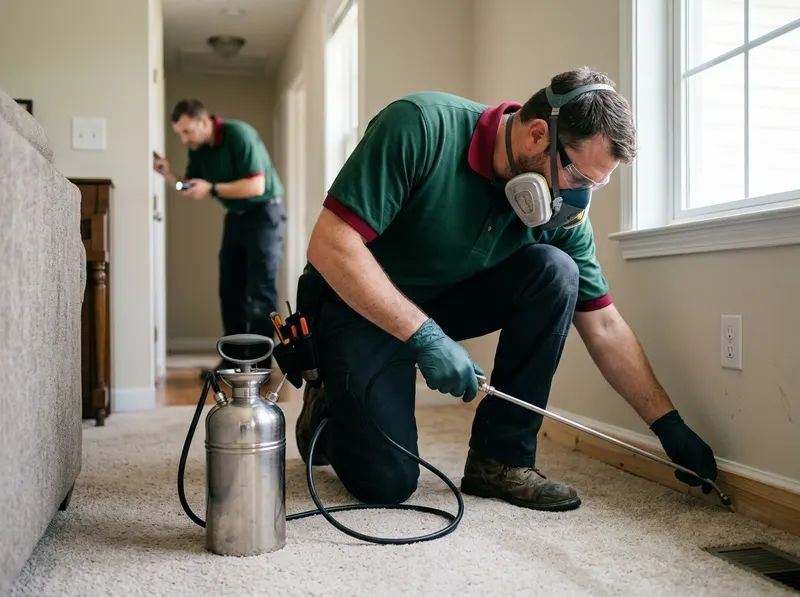
Flea populations in central North Carolina thrive under the humid subtropical climate of Guilford County, where sustained relative humidity above 50% accelerates the transition from egg to biting adult in just 14 to 21 days. In shaded, mature neighborhoods like Fisher Park, Westerwood, and Lindley Park, domestic dogs and cats frequently transport wandering adult fleas indoors from soil patches near foundational shrubbery. Once inside, 95% of the total flea population exists not on the domestic pet, but as microscopic eggs, larvae, and pupae settled deep inside rug fibers, hardwood expansion gaps, and beneath upholstered furniture cushions. Over-the-counter aerosol foggers discharge a broad mist that settles on horizontal surfaces without penetrating deep carpet pile, leaving pupal cocoons entirely viable. Professional flea remediation applies dedicated juvenile hormone mimics, such as pyriproxyfen or methoprene, directly into textile bases to permanently halt the molting cycle, coupled with targeted adulticides that neutralize active biting populations.
The mechanical trade-off during flea eradication balances the immediate knock-down of biting adults against the biological reality of the pupal window. Flea pupae reside inside protective silk cocoons that repel liquid applications and standard desiccants. Emerging adults break out of these cocoons across a 10 to 14 day period in response to carbon dioxide and mechanical vibration. Homes in sprawling residential zones like Adams Farm, Sedgefield, and Hamilton Lakes require continuous daily vacuuming following initial service to physically stimulate pupal emergence and pull newly hatched adults into contact with the residual barrier. If an infestation is confined to an uncarpeted guest suite or isolated laundry area, targeted spot application provides sufficient coverage; if domestic pets maintain free run across multi-story layouts in Starmount Forest or Latham Park, comprehensive whole-home remediation is necessary to prevent persistent re-infestation.
Technicians conduct an exhaustive preliminary assessment of indoor living zones to map out high-traffic domestic animal pathways and localized flea hot spots. Every product formulation utilized indoors is selected specifically to minimize volatile organic compounds, protecting indoor air quality while breaking the breeding nest without indiscriminate chemical broadcasting. Occupants and domestic animals vacate the structure during the service process and remain outside until all treated surfaces have completely dried, typically requiring a 3 to 4 hour window. A follow-up inspection at the 14-day mark verifies that the insect growth regulator has suppressed the secondary generational hatch, restoring the home to a clean, bite-free domestic sanctuary.
Every job gets a firm, written price after a free on-site visit.
Tell us about your residential flea infestation remediation job in Greensboro and we'll send a clear, written quote, usually the same day.
 CleanNest Pest Management